Breaking Apart an Object and Then Recomposing the Fragmented Pieces Art Defintion
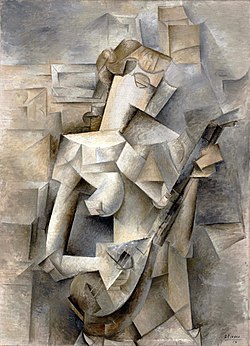
Cubism is an early-20th-century avant-garde art movement that revolutionized European painting and sculpture, and inspired related movements in music, literature and architecture. In Cubist artwork, objects are analyzed, cleaved up and reassembled in an bathetic form—instead of depicting objects from a single viewpoint, the artist depicts the subject from a multitude of viewpoints to represent the subject in a greater context.[1] Cubism has been considered the about influential art movement of the 20th century.[2] [3] The term is broadly used in association with a wide variety of art produced in Paris (Montmartre and Montparnasse) or near Paris (Puteaux) during the 1910s and throughout the 1920s.
The motility was pioneered by Pablo Picasso and Georges Braque, and joined by Jean Metzinger, Albert Gleizes, Robert Delaunay, Henri Le Fauconnier, Juan Gris, and Fernand Léger.[4] One primary influence that led to Cubism was the representation of three-dimensional form in the late works of Paul Cézanne.[5] A retrospective of Cézanne'southward paintings had been held at the Salon d'Automne of 1904, current works were displayed at the 1905 and 1906 Salon d'Automne, followed by ii commemorative retrospectives after his expiry in 1907.[6]
In French republic, offshoots of Cubism adult, including Orphism, abstract art and later Purism.[7] [8] The bear on of Cubism was far-reaching and wide-ranging. In France and other countries Futurism, Suprematism, Dada, Constructivism, Vorticism, De Stijl and Art Deco adult in response to Cubism. Early Futurist paintings agree in common with Cubism the fusing of the past and the nowadays, the representation of different views of the subject pictured at the same time or successively, too chosen multiple perspective, simultaneity or multiplicity,[9] while Constructivism was influenced by Picasso's technique of constructing sculpture from separate elements.[10] Other common threads between these disparate movements include the faceting or simplification of geometric forms, and the association of mechanization and modern life.
History [edit]
Historians have divided the history of Cubism into phases. In one scheme, the offset phase of Cubism, known as Analytic Cubism, a phrase coined by Juan Gris a posteriori,[xi] was both radical and influential as a short but highly significant art movement between 1910 and 1912 in France. A 2d stage, Constructed Cubism, remained vital until effectually 1919, when the Surrealist move gained popularity. English art historian Douglas Cooper proposed another scheme, describing three phases of Cubism in his book, The Cubist Epoch. Co-ordinate to Cooper there was "Early Cubism", (from 1906 to 1908) when the movement was initially developed in the studios of Picasso and Braque; the second phase being called "High Cubism", (from 1909 to 1914) during which time Juan Gris emerged as an of import exponent (afterwards 1911); and finally Cooper referred to "Late Cubism" (from 1914 to 1921) as the last phase of Cubism as a radical avant-garde movement.[12] Douglas Cooper's restrictive use of these terms to distinguish the piece of work of Braque, Picasso, Gris (from 1911) and Léger (to a lesser extent) unsaid an intentional value judgement.[v]


Pablo Picasso, 1909–10, Figure dans un Fauteuil (Seated Nude, Femme nue assise), oil on canvas, 92.1 × 73 cm, Tate Modern, London
Proto-Cubism: 1907–1908 [edit]
Cubism burgeoned between 1907 and 1911. Pablo Picasso'due south 1907 painting Les Demoiselles d'Avignon has often been considered a proto-Cubist work.
In 1908, in his review of Georges Braque'due south exhibition at Kahnweiler's gallery, the critic Louis Vauxcelles chosen Braque a daring homo who despises form, "reducing everything, places and a figures and houses, to geometric schemas, to cubes".[14] [xv]
Vauxcelles recounted how Matisse told him at the time, "Braque has just sent in [to the 1908 Salon d'Automne] a painting made of little cubes".[15] The critic Charles Morice relayed Matisse's words and spoke of Braque'southward little cubes. The motif of the viaduct at 50'Estaque had inspired Braque to produce three paintings marked by the simplification of form and deconstruction of perspective.[16]
Georges Braque's 1908 Houses at L'Estaque (and related works) prompted Vauxcelles, in Gil Blas, 25 March 1909, to refer to bizarreries cubiques (cubic oddities).[17] Gertrude Stein referred to landscapes fabricated past Picasso in 1909, such equally Reservoir at Horta de Ebro, as the starting time Cubist paintings. The starting time organized group exhibition by Cubists took place at the Salon des Indépendants in Paris during the jump of 1911 in a room called 'Salle 41'; it included works by Jean Metzinger, Albert Gleizes, Fernand Léger, Robert Delaunay and Henri Le Fauconnier, yet no works by Picasso or Braque were exhibited.[5]
By 1911 Picasso was recognized every bit the inventor of Cubism, while Braque's importance and precedence was argued later on, with respect to his treatment of space, volume and mass in the 50'Estaque landscapes. But "this view of Cubism is associated with a distinctly restrictive definition of which artists are properly to be chosen Cubists," wrote the fine art historian Christopher Dark-green: "Marginalizing the contribution of the artists who exhibited at the Salon des Indépendants in 1911 [...]"[5]
The exclamation that the Cubist depiction of infinite, mass, time, and book supports (rather than contradicts) the flatness of the canvas was made by Daniel-Henry Kahnweiler as early on as 1920,[18] but it was subject to criticism in the 1950s and 1960s, especially past Clement Greenberg.[19]
Contemporary views of Cubism are circuitous, formed to some extent in response to the "Salle 41" Cubists, whose methods were too distinct from those of Picasso and Braque to be considered merely secondary to them. Alternative interpretations of Cubism have therefore adult. Wider views of Cubism include artists who were later associated with the "Salle 41" artists, east.g., Francis Picabia; the brothers Jacques Villon, Raymond Duchamp-Villon and Marcel Duchamp, who beginning in late 1911 formed the core of the Department d'Or (or the Puteaux Group); the sculptors Alexander Archipenko, Joseph Csaky and Ossip Zadkine also as Jacques Lipchitz and Henri Laurens; and painters such as Louis Marcoussis, Roger de La Fresnaye, František Kupka, Diego Rivera, Léopold Survage, Auguste Herbin, André Lhote, Gino Severini (subsequently 1916), María Blanchard (after 1916) and Georges Valmier (after 1918). More fundamentally, Christopher Green argues that Douglas Cooper's terms were "afterwards undermined by interpretations of the piece of work of Picasso, Braque, Gris and Léger that stress iconographic and ideological questions rather than methods of representation."[5]
John Berger identifies the essence of Cubism with the mechanical diagram. "The metaphorical model of Cubism is the diagram: The diagram being a visible symbolic representation of invisible processes, forces, structures. A diagram need non eschew certain aspects of appearance but these too will be treated as signs non as imitations or recreations."[xx]
Early Cubism: 1909–1914 [edit]

Albert Gleizes, L'Homme au Balcon, Human being on a Balcony (Portrait of Dr. Théo Morinaud), 1912, oil on canvas, 195.6 × 114.9 cm (77 × 45 1/iv in.), Philadelphia Museum of Fine art. Completed the aforementioned twelvemonth that Albert Gleizes co-authored the book Du "Cubisme" with Jean Metzinger. Exhibited at Salon d'Automne, Paris, 1912, Armory prove, New York, Chicago, Boston, 1913
There was a distinct departure between Kahnweiler's Cubists and the Salon Cubists. Prior to 1914, Picasso, Braque, Gris and Léger (to a lesser extent) gained the support of a single committed art dealer in Paris, Daniel-Henry Kahnweiler, who guaranteed them an annual income for the sectional correct to purchase their works. Kahnweiler sold only to a small circle of connoisseurs. His support gave his artists the freedom to experiment in relative privacy. Picasso worked in Montmartre until 1912, while Braque and Gris remained in that location until after the First Globe War. Léger was based in Montparnasse.[5]
In contrast, the Salon Cubists built their reputation primarily past exhibiting regularly at the Salon d'Automne and the Salon des Indépendants, both major non-bookish Salons in Paris. They were inevitably more aware of public response and the need to communicate.[5] Already in 1910 a group began to grade which included Metzinger, Gleizes, Delaunay and Léger. They met regularly at Henri le Fauconnier's studio near the boulevard du Montparnasse. These soirées often included writers such as Guillaume Apollinaire and André Salmon. Together with other young artists, the group wanted to emphasise a research into form, in opposition to the Neo-Impressionist emphasis on colour.[21]
Louis Vauxcelles, in his review of the 26th Salon des Indépendants (1910), made a passing and imprecise reference to Metzinger, Gleizes, Delaunay, Léger and Le Fauconnier as "ignorant geometers, reducing the human body, the site, to pallid cubes."[22] [23] At the 1910 Salon d'Automne, a few months later, Metzinger exhibited his highly fractured Nu à la cheminée (Nude), which was after reproduced in both Du "Cubisme" (1912) and Les Peintres Cubistes (1913).[24]
The first public controversy generated by Cubism resulted from Salon showings at the Indépendants during the spring of 1911. This showing by Metzinger, Gleizes, Delaunay, le Fauconnier and Léger brought Cubism to the attention of the general public for the first time. Amongst the Cubist works presented, Robert Delaunay exhibited his Eiffel Tower, Tour Eiffel (Solomon R. Guggenheim Museum, New York).[25]

The "Cubists" Dominate Paris' Fall Salon, The New York Times, October 8, 1911. Picasso'southward 1908 Seated Woman (Meditation) is reproduced along with a photograph of the artist in his studio (upper left). Metzinger'southward Baigneuses (1908–09) is reproduced top right. Also reproduced are works by Derain, Matisse, Friesz, Herbin, and a photograph of Braque
At the Salon d'Automne of the same year, in add-on to the Indépendants grouping of Salle 41, were exhibited works past André Lhote, Marcel Duchamp, Jacques Villon, Roger de La Fresnaye, André Dunoyer de Segonzac and František Kupka. The exhibition was reviewed in the Oct 8, 1911 issue of The New York Times. This article was published a yr later on Gelett Burgess' The Wild Men of Paris,[26] and ii years prior to the Armory Show, which introduced astonished Americans, accustomed to realistic art, to the experimental styles of the European avant garde, including Fauvism, Cubism, and Futurism. The 1911 New York Times article portrayed works by Picasso, Matisse, Derain, Metzinger and others dated before 1909; not exhibited at the 1911 Salon. The commodity was titled The "Cubists" Dominate Paris' Autumn Salon and subtitled Eccentric Schoolhouse of Painting Increases Its Vogue in the Current Art Exhibition – What Its Followers Attempt to Exercise. [27] [28]
Among all the paintings on exhibition at the Paris Fall Salon none is alluring so much attention every bit the boggling productions of the so-called "Cubist" schoolhouse. In fact, dispatches from Paris suggest that these works are easily the primary feature of the exhibition. [...]
In spite of the crazy nature of the "Cubist" theories the number of those professing them is adequately respectable. Georges Braque, André Derain, Picasso, Czobel, Othon Friesz, Herbin, Metzinger—these are a few of the names signed to canvases before which Paris has stood and now again stands in blank anaesthesia.
What do they mean? Have those responsible for them taken leave of their senses? Is it art or madness? Who knows?[27] [28]
Salon des Indépendants [edit]
The subsequent 1912 Salon des Indépendants located in Paris (20 March to xvi May 1912) was marked by the presentation of Marcel Duchamp'due south Nude Descending a Staircase, No. two, which itself acquired a scandal, even amongst the Cubists. It was in fact rejected past the hanging committee, which included his brothers and other Cubists. Although the work was shown in the Salon de la Section d'Or in October 1912 and the 1913 Armory Bear witness in New York, Duchamp never forgave his brothers and sometime colleagues for censoring his work.[21] [29] Juan Gris, a new addition to the Salon scene, exhibited his Portrait of Picasso (Fine art Institute of Chicago), while Metzinger'due south two showings included La Femme au Cheval (Woman with a horse) 1911–1912 (National Gallery of Denmark).[thirty] Delaunay's awe-inspiring La Ville de Paris (Musée d'art moderne de la Ville de Paris) and Léger's La Noce, The Wedding (Musée National d'Art Moderne, Paris), were also exhibited.
Galeries Dalmau [edit]
In 1912, Galeries Dalmau presented the get-go declared group exhibition of Cubism worldwide (Exposició d'Art Cubista),[31] [32] [33] with a controversial showing past Jean Metzinger, Albert Gleizes, Juan Gris, Marie Laurencin and Marcel Duchamp (Barcelona, 20 April to 10 May 1912). The Dalmau exhibition comprised 83 works by 26 artists.[34] [35] [36] Jacques Nayral'south association with Gleizes led him to write the Preface for the Cubist exhibition,[31] which was fully translated and reproduced in the newspaper La Veu de Catalunya.[37] [38] Duchamp's Nude Descending a Staircase, No. 2 was exhibited for the commencement time.[39]
Extensive media coverage (in newspapers and magazines) before, during and later the exhibition launched the Galeries Dalmau as a force in the evolution and propagation of modernism in Europe.[39] While printing coverage was extensive, it was non ever positive. Manufactures were published in the newspapers Esquella de La Torratxa [forty] and El Noticiero Universal [41] attacking the Cubists with a series of caricatures laced with derogatory text.[41] Art historian Jaime Brihuega writes of the Dalmau show: "No doubt that the exhibition produced a strong commotion in the public, who welcomed it with a lot of suspicion.[42]
Salon d'Automne [edit]
The Cubist contribution to the 1912 Salon d'Automne created scandal regarding the use of regime endemic buildings, such every bit the Grand Palais, to exhibit such artwork. The indignation of the pol Jean Pierre Philippe Lampué made the front end folio of Le Periodical, 5 October 1912.[43] The controversy spread to the Municipal Quango of Paris, leading to a debate in the Chambre des Députés most the use of public funds to provide the venue for such art.[44] The Cubists were defended past the Socialist deputy, Marcel Sembat.[44] [45] [46]
Information technology was against this groundwork of public anger that Jean Metzinger and Albert Gleizes wrote Du "Cubisme" (published past Eugène Figuière in 1912, translated to English and Russian in 1913).[47] Among the works exhibited were Le Fauconnier'southward vast composition Les Montagnards attaqués par des ours (Mountaineers Attacked by Bears) at present at Rhode Island School of Design Museum, Joseph Csaky's Deux Femme, Two Women (a sculpture now lost), in improver to the highly abstruse paintings by Kupka, Amorpha (The National Gallery, Prague), and Picabia, La Source (The Spring) (Museum of Modern Art, New York).
Abstraction and the ready-fabricated [edit]

The near extreme forms of Cubism were not those practiced by Picasso and Braque, who resisted total abstraction. Other Cubists, by contrast, especially František Kupka, and those considered Orphists past Apollinaire (Delaunay, Léger, Picabia and Duchamp), accepted abstraction by removing visible subject matter entirely. Kupka's two entries at the 1912 Salon d'Automne, Amorpha-Fugue à deux couleurs and Amorpha chromatique chaude, were highly abstruse (or nonrepresentational) and metaphysical in orientation. Both Duchamp in 1912 and Picabia from 1912 to 1914 adult an expressive and allusive abstraction dedicated to complex emotional and sexual themes. Beginning in 1912 Delaunay painted a series of paintings entitled Simultaneous Windows, followed by a serial entitled Formes Circulaires, in which he combined planar structures with brilliant prismatic hues; based on the optical characteristics of juxtaposed colors his departure from reality in the depiction of imagery was quasi-complete. In 1913–14 Léger produced a series entitled Contrasts of Forms, giving a similar stress to colour, line and form. His Cubism, despite its abstract qualities, was associated with themes of mechanization and modern life. Apollinaire supported these early developments of abstract Cubism in Les Peintres cubistes (1913),[24] writing of a new "pure" painting in which the subject was vacated. But in spite of his employ of the term Orphism these works were so different that they defy attempts to identify them in a single category.[5]
Also labeled an Orphist by Apollinaire, Marcel Duchamp was responsible for another farthermost development inspired by Cubism. The ready-made arose from a articulation consideration that the work itself is considered an object (just as a painting), and that it uses the textile detritus of the world (equally collage and papier collé in the Cubist structure and Assemblage). The next logical step, for Duchamp, was to nowadays an ordinary object as a self-sufficient work of art representing but itself. In 1913 he attached a bicycle wheel to a kitchen stool and in 1914 selected a bottle-drying rack as a sculpture in its own right.[v]
Section d'Or [edit]

The Section d'Or, likewise known as Groupe de Puteaux, founded past some of the about conspicuous Cubists, was a commonage of painters, sculptors and critics associated with Cubism and Orphism, agile from 1911 through about 1914, coming to prominence in the wake of their controversial showing at the 1911 Salon des Indépendants. The Salon de la Section d'Or at the Galerie La Boétie in Paris, October 1912, was arguably the most important pre-Earth State of war I Cubist exhibition; exposing Cubism to a wide audience. Over 200 works were displayed, and the fact that many of the artists showed artworks representative of their development from 1909 to 1912 gave the exhibition the attraction of a Cubist retrospective.[48]
The group seems to have adopted the name Section d'Or to distinguish themselves from the narrower definition of Cubism adult in parallel by Pablo Picasso and Georges Braque in the Montmartre quarter of Paris, and to show that Cubism, rather than being an isolated art-class, represented the continuation of a thou tradition (indeed, the golden ratio had fascinated Western intellectuals of diverse interests for at least 2,400 years).[49]
The thought of the Section d'Or originated in the form of conversations between Metzinger, Gleizes and Jacques Villon. The group'south title was suggested past Villon, after reading a 1910 translation of Leonardo da Vinci's Trattato della Pittura by Joséphin Péladan.
During the late 19th and early 20th centuries, Europeans were discovering African, Polynesian, Micronesian and Native American art. Artists such as Paul Gauguin, Henri Matisse, and Pablo Picasso were intrigued and inspired past the stark power and simplicity of styles of those foreign cultures. Around 1906, Picasso met Matisse through Gertrude Stein, at a time when both artists had recently acquired an interest in primitivism, Iberian sculpture, African fine art and African tribal masks. They became friendly rivals and competed with each other throughout their careers, peradventure leading to Picasso entering a new period in his work by 1907, marked by the influence of Greek, Iberian and African fine art. Picasso's paintings of 1907 have been characterized as Protocubism, as notably seen in Les Demoiselles d'Avignon, the ancestor of Cubism.[13]

The art historian Douglas Cooper states that Paul Gauguin and Paul Cézanne "were particularly influential to the germination of Cubism and especially of import to the paintings of Picasso during 1906 and 1907".[50] Cooper goes on to say: "The Demoiselles is generally referred to equally the first Cubist picture. This is an exaggeration, for although information technology was a major first footstep towards Cubism it is not nonetheless Cubist. The confusing, expressionist element in information technology is even contrary to the spirit of Cubism, which looked at the globe in a detached, realistic spirit. However, the Demoiselles is the logical picture to accept as the starting bespeak for Cubism, because information technology marks the birth of a new pictorial idiom, because in it Picasso violently overturned established conventions and because all that followed grew out of it."[13]
The nearly serious objection to regarding the Demoiselles every bit the origin of Cubism, with its evident influence of archaic art, is that "such deductions are unhistorical", wrote the art historian Daniel Robbins. This familiar explanation "fails to give adequate consideration to the complexities of a flourishing fine art that existed just before and during the period when Picasso's new painting adult."[51] Between 1905 and 1908, a conscious search for a new style acquired rapid changes in art beyond French republic, Germany, Holland, Italy, and Russia. The Impressionists had used a double bespeak of view, and both Les Nabis and the Symbolists (who also admired Cézanne) flattened the picture plane, reducing their subjects to simple geometric forms. Neo-Impressionist construction and subject matter, near notably to be seen in the works of Georges Seurat (eastward.g., Parade de Cirque, Le Chahut and Le Cirque), was another important influence. In that location were likewise parallels in the development of literature and social idea.[51]
In addition to Seurat, the roots of cubism are to be found in the 2 distinct tendencies of Cézanne's later work: get-go his breaking of the painted surface into small multifaceted areas of pigment, thereby emphasizing the plural viewpoint given by binocular vision, and second his interest in the simplification of natural forms into cylinders, spheres, and cones. Withal, the cubists explored this concept further than Cézanne. They represented all the surfaces of depicted objects in a single film airplane, as if the objects had all their faces visible at the same fourth dimension. This new kind of depiction revolutionized the mode objects could be visualized in painting and art.

The historical report of Cubism began in the late 1920s, drawing at first from sources of limited data, namely the opinions of Guillaume Apollinaire. Information technology came to rely heavily on Daniel-Henry Kahnweiler'southward book Der Weg zum Kubismus (published in 1920), which centered on the developments of Picasso, Braque, Léger, and Gris. The terms "belittling" and "synthetic" which later emerged take been widely accepted since the mid-1930s. Both terms are historical impositions that occurred later the facts they identify. Neither phase was designated as such at the time respective works were created. "If Kahnweiler considers Cubism as Picasso and Braque," wrote Daniel Robbins, "our only error is in subjecting other Cubists' works to the rigors of that limited definition."[51]
The traditional interpretation of "Cubism", formulated post facto every bit a means of understanding the works of Braque and Picasso, has affected our appreciation of other twentieth-century artists. It is difficult to apply to painters such as Jean Metzinger, Albert Gleizes, Robert Delaunay and Henri Le Fauconnier, whose central differences from traditional Cubism compelled Kahnweiler to question whether to phone call them Cubists at all. According to Daniel Robbins, "To advise that only because these artists adult differently or varied from the traditional blueprint they deserved to be relegated to a secondary or satellite role in Cubism is a profound mistake."[51]
The history of the term "Cubism" unremarkably stresses the fact that Matisse referred to "cubes" in connexion with a painting by Braque in 1908, and that the term was published twice past the critic Louis Vauxcelles in a similar context. Notwithstanding, the word "cube" was used in 1906 past some other critic, Louis Chassevent, with reference not to Picasso or Braque but rather to Metzinger and Delaunay:
-
- "M. Metzinger is a mosaicist like Thou. Signac but he brings more precision to the cutting of his cubes of color which appear to accept been made mechanically [...]".[51] [52] [53]
The critical use of the word "cube" goes dorsum at least to May 1901 when Jean Béral, reviewing the work of Henri-Edmond Cross at the Indépendants in Fine art et Littérature, commented that he "uses a large and foursquare pointillism, giving the impression of mosaic. One fifty-fifty wonders why the artist has not used cubes of solid matter diversely colored: they would brand pretty revetments." (Robert Herbert, 1968, p. 221)[53]
The term Cubism did non come into full general usage until 1911, mainly with reference to Metzinger, Gleizes, Delaunay, and Léger.[51] In 1911, the poet and critic Guillaume Apollinaire accepted the term on behalf of a grouping of artists invited to showroom at the Brussels Indépendants. The following year, in preparation for the Salon de la Section d'Or, Metzinger and Gleizes wrote and published Du "Cubisme" [54] in an effort to dispel the confusion raging around the word, and as a major defense force of Cubism (which had acquired a public scandal following the 1911 Salon des Indépendants and the 1912 Salon d'Automne in Paris).[55] Clarifying their aims as artists, this work was the outset theoretical treatise on Cubism and it all the same remains the clearest and most intelligible. The result, not solely a collaboration between its two authors, reflected discussions by the circle of artists who met in Puteaux and Courbevoie. It mirrored the attitudes of the "artists of Passy", which included Picabia and the Duchamp brothers, to whom sections of it were read prior to publication.[5] [51] The concept developed in Du "Cubisme" of observing a bailiwick from different points in space and time simultaneously, i.e., the human action of moving effectually an object to seize it from several successive angles fused into a unmarried image (multiple viewpoints, mobile perspective, simultaneity or multiplicity), is a mostly recognized device used by the Cubists.[56]
The 1912 manifesto Du "Cubisme" by Metzinger and Gleizes was followed in 1913 by Les Peintres Cubistes, a collection of reflections and commentaries by Guillaume Apollinaire.[24] Apollinaire had been closely involved with Picasso beginning in 1905, and Braque commencement in 1907, but gave every bit much attention to artists such equally Metzinger, Gleizes, Delaunay, Picabia, and Duchamp.[v]
The fact that the 1912 exhibition had been curated to show the successive stages through which Cubism had transited, and that Du "Cubisme" had been published for the occasion, indicates the artists' intention of making their work comprehensible to a wide audience (art critics, art collectors, fine art dealers and the general public). Undoubtedly, due to the great success of the exhibition, Cubism became avant-garde movement recognized as a genre or style in art with a specific common philosophy or goal.[48]
Crystal Cubism: 1914–1918 [edit]
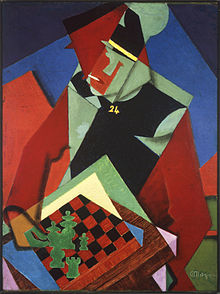
A significant modification of Cubism between 1914 and 1916 was signaled by a shift towards a strong emphasis on large overlapping geometric planes and flat surface activity. This group of styles of painting and sculpture, specially pregnant between 1917 and 1920, was good by several artists; especially those under contract with the art dealer and collector Léonce Rosenberg. The tightening of the compositions, the clarity and sense of gild reflected in these works, led to its being referred to by the critic Maurice Raynal every bit 'crystal' Cubism. Considerations manifested by Cubists prior to the outset of Earth War I—such every bit the time, dynamism of modernistic life, the occult, and Henri Bergson's concept of duration—had now been vacated, replaced by a purely formal frame of reference.[57]
Crystal Cubism, and its associative rappel à fifty'ordre, has been linked with an inclination—past those who served the armed services and by those who remained in the civilian sector—to escape the realities of the Great State of war, both during and directly following the conflict. The purifying of Cubism from 1914 through the mid-1920s, with its cohesive unity and voluntary constraints, has been linked to a much broader ideological transformation towards conservatism in both French society and French civilisation.[5]
Cubism subsequently 1918 [edit]

The well-nigh innovative period of Cubism was before 1914[ commendation needed ]. After World War I, with the back up given past the dealer Léonce Rosenberg, Cubism returned as a central issue for artists, and connected equally such until the mid-1920s when its avant-garde condition was rendered questionable by the emergence of geometric abstraction and Surrealism in Paris. Many Cubists, including Picasso, Braque, Gris, Léger, Gleizes, and Metzinger, while developing other styles, returned periodically to Cubism, even well later on 1925. Cubism reemerged during the 1920s and the 1930s in the work of the American Stuart Davis and the Englishman Ben Nicholson. In French republic, however, Cubism experienced a turn down get-go in almost 1925. Léonce Rosenberg exhibited not only the artists stranded by Kahnweiler'due south exile but others including Laurens, Lipchitz, Metzinger, Gleizes, Csaky, Herbin and Severini. In 1918 Rosenberg presented a series of Cubist exhibitions at his Galerie de l'Effort Moderne in Paris. Attempts were fabricated past Louis Vauxcelles to argue that Cubism was dead, simply these exhibitions, forth with a well-organized Cubist evidence at the 1920 Salon des Indépendants and a revival of the Salon de la Department d'Or in the same yr, demonstrated it was nevertheless live.[v]
The reemergence of Cubism coincided with the appearance from near 1917–24 of a coherent body of theoretical writing past Pierre Reverdy, Maurice Raynal and Daniel-Henry Kahnweiler and, among the artists, past Gris, Léger and Gleizes. The occasional render to classicism—figurative piece of work either exclusively or alongside Cubist work—experienced past many artists during this period (called Neoclassicism) has been linked to the tendency to evade the realities of the war and too to the cultural dominance of a classical or Latin paradigm of French republic during and immediately following the war. Cubism later 1918 can be seen equally part of a wide ideological shift towards conservatism in both French lodge and culture. Still, Cubism itself remained evolutionary both inside the oeuvre of private artists, such every bit Gris and Metzinger, and across the work of artists every bit dissimilar from each other as Braque, Léger and Gleizes. Cubism as a publicly debated motion became relatively unified and open up to definition. Its theoretical purity made information technology a gauge against which such diverse tendencies as Realism or Naturalism, Dada, Surrealism and abstraction could be compared.[5]
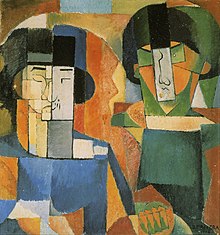
Diego Rivera, Portrait de Messieurs Kawashima et Foujita, 1914
Influence in Asia [edit]
Japan and China were amongst the first countries in Asia to exist influenced by Cubism. Contact first occurred via European texts translated and published in Japanese art journals in the 1910s. In the 1920s, Japanese and Chinese artists who studied in Paris, for example those enrolled at the École nationale supérieure des Beaux-Arts, brought dorsum with them both an understanding of modern art movements, including Cubism. Notable works exhibiting Cubist qualities were Tetsugorō Yorozu's Self Portrait with Ruddy Optics (1912) and Fang Ganmin's Melody in Fall (1934).[59] [60]
Interpretation [edit]
Intentions and criticism [edit]

The Cubism of Picasso and Braque had more than a technical or formal significance, and the singled-out attitudes and intentions of the Salon Cubists produced different kinds of Cubism, rather than a derivative of their work. "It is past no means clear, in whatsoever case," wrote Christopher Light-green, "to what extent these other Cubists depended on Picasso and Braque for their development of such techniques as faceting, 'passage' and multiple perspective; they could well have arrived at such practices with little knowledge of 'truthful' Cubism in its early stages, guided in a higher place all by their ain understanding of Cézanne." The works exhibited by these Cubists at the 1911 and 1912 Salons extended beyond the conventional Cézanne-like subjects—the posed model, still-life and landscape—favored by Picasso and Braque to include large-scale mod-life subjects. Aimed at a large public, these works stressed the apply of multiple perspective and complex planar faceting for expressive effect while preserving the eloquence of subjects endowed with literary and philosophical connotations.[5]
In Du "Cubisme" Metzinger and Gleizes explicitly related the sense of fourth dimension to multiple perspective, giving symbolic expression to the notion of 'duration' proposed past the philosopher Henri Bergson according to which life is subjectively experienced as a continuum, with the past flowing into the present and the present merging into the future. The Salon Cubists used the faceted treatment of solid and space and effects of multiple viewpoints to convey a physical and psychological sense of the fluidity of consciousness, blurring the distinctions between past, present and future. 1 of the major theoretical innovations made by the Salon Cubists, independently of Picasso and Braque, was that of simultaneity,[5] drawing to greater or bottom extent on theories of Henri Poincaré, Ernst Mach, Charles Henry, Maurice Princet, and Henri Bergson. With simultaneity, the concept of separate spatial and temporal dimensions was comprehensively challenged. Linear perspective developed during the Renaissance was vacated. The subject matter was no longer considered from a specific indicate of view at a moment in time, but built following a selection of successive viewpoints, i.east., as if viewed simultaneously from numerous angles (and in multiple dimensions) with the eye free to roam from one to the other.[56]
This technique of representing simultaneity, multiple viewpoints (or relative motion) is pushed to a high caste of complexity in Metzinger's Nu à la cheminée, exhibited at the 1910 Salon d'Automne; Gleizes' awe-inspiring Le Dépiquage des Moissons (Harvest Threshing), exhibited at the 1912 Salon de la Section d'Or; Le Fauconnier'south Abundance shown at the Indépendants of 1911; and Delaunay's City of Paris, exhibited at the Indépendants in 1912. These aggressive works are some of the largest paintings in the history of Cubism. Léger'southward The Wedding, as well shown at the Salon des Indépendants in 1912, gave grade to the notion of simultaneity by presenting different motifs as occurring within a single temporal frame, where responses to the past and present interpenetrate with collective force. The conjunction of such subject affair with simultaneity aligns Salon Cubism with early on Futurist paintings by Umberto Boccioni, Gino Severini and Carlo Carrà; themselves made in response to early Cubism.[ix]
Cubism and modern European art was introduced into the United states at the now legendary 1913 Armory Show in New York City, which and so traveled to Chicago and Boston. In the Arsenal show Pablo Picasso exhibited La Femme au pot de moutarde (1910), the sculpture Head of a Adult female (Fernande) (1909–10), Les Arbres (1907) among other cubist works. Jacques Villon exhibited vii of import and big drypoints, while his brother Marcel Duchamp shocked the American public with his painting Nude Descending a Staircase, No. 2 (1912). Francis Picabia exhibited his abstractions La Danse à la source and La Procession, Seville (both of 1912). Albert Gleizes exhibited La Femme aux phlox (1910) and L'Homme au balcon (1912), ii highly stylized and faceted cubist works. Georges Braque, Fernand Léger, Raymond Duchamp-Villon, Roger de La Fresnaye and Alexander Archipenko also contributed examples of their cubist works.
Cubist sculpture [edit]


Frontal view of the aforementioned bronze cast, 40.5 × 23 × 26 cm
These photos were published in Umělecký Mĕsíčník, 1913[62]
Just as in painting, Cubist sculpture is rooted in Paul Cézanne's reduction of painted objects into component planes and geometric solids (cubes, spheres, cylinders, and cones). And merely as in painting, it became a pervasive influence and contributed fundamentally to Constructivism and Futurism.
Cubist sculpture developed in parallel to Cubist painting. During the autumn of 1909 Picasso sculpted Head of a Adult female (Fernande) with positive features depicted past negative space and vice versa. According to Douglas Cooper: "The first true Cubist sculpture was Picasso's impressive Woman'southward Head, modeled in 1909–10, a counterpart in iii dimensions to many similar analytical and faceted heads in his paintings at the fourth dimension."[12] These positive/negative reversals were ambitiously exploited past Alexander Archipenko in 1912–thirteen, for case in Adult female Walking.[5] Joseph Csaky, after Archipenko, was the first sculptor in Paris to join the Cubists, with whom he exhibited from 1911 onwards. They were followed by Raymond Duchamp-Villon and then in 1914 past Jacques Lipchitz, Henri Laurens and Ossip Zadkine.[63] [64]
Indeed, Cubist construction was as influential every bit whatever pictorial Cubist innovation. It was the stimulus behind the proto-Constructivist piece of work of both Naum Gabo and Vladimir Tatlin and thus the starting-indicate for the entire constructive tendency in 20th-century modernist sculpture.[5]
Architecture [edit]

Le Corbusier, Assembly building, Chandigarh, India
Cubism formed an important link between early on-20th-century art and architecture.[65] The historical, theoretical, and socio-political relationships between avant-garde practices in painting, sculpture and architecture had early ramifications in France, Federal republic of germany, the netherlands and Czechoslovakia. Though in that location are many points of intersection betwixt Cubism and compages, simply a few direct links between them tin can be drawn. Most oftentimes the connections are fabricated by reference to shared formal characteristics: faceting of form, spatial ambiguity, transparency, and multiplicity.[65]
Architectural involvement in Cubism centered on the dissolution and reconstitution of three-dimensional form, using elementary geometric shapes, juxtaposed without the illusions of classical perspective. Various elements could exist superimposed, fabricated transparent or penetrate one some other, while retaining their spatial relationships. Cubism had become an influential factor in the development of modern architecture from 1912 (La Maison Cubiste, by Raymond Duchamp-Villon and André Mare) onwards, developing in parallel with architects such as Peter Behrens and Walter Gropius, with the simplification of building pattern, the use of materials advisable to industrial production, and the increased use of glass.[66]

Cubism was relevant to an architecture seeking a style that needed not refer to the by. Thus, what had become a revolution in both painting and sculpture was applied as part of "a profound reorientation towards a changed world".[66] [67] The Cubo-Futurist ideas of Filippo Tommaso Marinetti influenced attitudes in advanced architecture. The influential De Stijl movement embraced the artful principles of Neo-plasticism developed by Piet Mondrian nether the influence of Cubism in Paris. De Stijl was also linked by Gino Severini to Cubist theory through the writings of Albert Gleizes. Notwithstanding, the linking of basic geometric forms with inherent beauty and ease of industrial application—which had been prefigured past Marcel Duchamp from 1914—was left to the founders of Purism, Amédée Ozenfant and Charles-Édouard Jeanneret (amend known as Le Corbusier,) who exhibited paintings together in Paris and published Après le cubisme in 1918.[66] Le Corbusier's appetite had been to translate the properties of his ain style of Cubism to architecture. Between 1918 and 1922, Le Corbusier concentrated his efforts on Purist theory and painting. In 1922, Le Corbusier and his cousin Jeanneret opened a studio in Paris at 35 rue de Sèvres. His theoretical studies shortly advanced into many dissimilar architectural projects.[68]
La Maison Cubiste (Cubist House) [edit]

Raymond Duchamp-Villon, 1912, Written report for La Maison Cubiste, Projet d'Hotel (Cubist House). Image published in Les Peintres Cubistes, by Guillaume Apollinaire, 17 March 1913

Le Salon Conservative, designed by André Mare for La Maison Cubiste, in the decorative arts section of the Salon d'Automne, 1912, Paris. Metzinger's Femme à fifty'Éventail on the left wall
At the 1912 Salon d'Automne an architectural installation was exhibited that quickly became known every bit Maison Cubiste (Cubist Business firm), with architecture by Raymond Duchamp-Villon and interior decoration past André Mare forth with a group of collaborators. Metzinger and Gleizes in Du "Cubisme", written during the aggregation of the "Maison Cubiste", wrote about the democratic nature of fine art, stressing the point that decorative considerations should not govern the spirit of art. Decorative work, to them, was the "antithesis of the picture show". "The true moving picture" wrote Metzinger and Gleizes, "bears its raison d'être inside itself. Information technology can be moved from a church to a cartoon-room, from a museum to a study. Substantially independent, necessarily complete, information technology need non immediately satisfy the mind: on the opposite, it should lead it, little by little, towards the fictitious depths in which the coordinative light resides. It does not harmonize with this or that ensemble; information technology harmonizes with things in general, with the universe: it is an organism...".[69]
La Maison Cubiste was a fully furnished model house, with a facade, a staircase, wrought atomic number 26 banisters, and 2 rooms: a living room—the Salon Bourgeois, where paintings by Marcel Duchamp, Metzinger (Woman with a Fan), Gleizes, Laurencin and Léger were hung, and a bedroom. It was an example of L'fine art décoratif, a dwelling within which Cubist fine art could be displayed in the comfort and fashion of modern, bourgeois life. Spectators at the Salon d'Automne passed through the plaster facade, designed by Duchamp-Villon, to the two furnished rooms.[70] This architectural installation was subsequently exhibited at the 1913 Armory Show, New York, Chicago and Boston,[71] listed in the catalogue of the New York exhibit every bit Raymond Duchamp-Villon, number 609, and entitled "Facade architectural, plaster" (Façade architecturale).[72] [73]

Jacques Doucet'due south hôtel particulier, 33 rue Saint-James, Neuilly-sur-Seine
The furnishings, wallpaper, upholstery and carpets of the interior were designed by André Mare, and were early on examples of the influence of cubism on what would become Art Deco. They were composed of very brightly colored roses and other floral patterns in stylized geometric forms.
Mare called the living room in which Cubist paintings were hung the Salon Bourgeois. Léger described this name as 'perfect'. In a letter to Mare prior to the exhibition Léger wrote: "Your idea is absolutely splendid for us, really splendid. People volition come across Cubism in its domestic setting, which is very of import.[2]
"Mare's ensembles were accepted as frames for Cubist works because they allowed paintings and sculptures their independence", Christopher Greenish wrote, "creating a play of contrasts, hence the involvement not simply of Gleizes and Metzinger themselves, just of Marie Laurencin, the Duchamp brothers (Raymond Duchamp-Villon designed the facade) and Mare's old friends Léger and Roger La Fresnaye".[74]
In 1927, Cubists Joseph Csaky, Jacques Lipchitz, Louis Marcoussis, Henri Laurens, the sculptor Gustave Miklos, and others collaborated in the decoration of a Studio House, rue Saint-James, Neuilly-sur-Seine, designed by the builder Paul Ruaud and owned by the French manner designer Jacques Doucet, too a collector of Post-Impressionist and Cubist paintings (including Les Demoiselles d'Avignon, which he bought directly from Picasso's studio). Laurens designed the fountain, Csaky designed Doucet's staircase,[75] Lipchitz made the fireplace mantel, and Marcoussis fabricated a Cubist rug.[76] [77] [78]
Czech Cubist architecture [edit]

The original Cubist architecture is very rare. Cubism was applied to compages only in Bohemia (today Czech Republic) and especially in its capital, Prague.[79] [80] Czech architects were the outset and only ones to e'er design original Cubist buildings.[81] Cubist architecture flourished for the most part between 1910 and 1914, merely the Cubist or Cubism-influenced buildings were likewise built later Earth War I. After the state of war, the architectural style called Rondo-Cubism was adult in Prague fusing the Cubist architecture with circular shapes.[82]

In their theoretical rules, the Cubist architects expressed the requirement of dynamism, which would surmount the affair and calm independent in it, through a artistic idea, then that the result would evoke feelings of dynamism and expressive plasticity in the viewer. This should be achieved by shapes derived from pyramids, cubes and prisms, by arrangements and compositions of oblique surfaces, mainly triangular, sculpted facades in protruding crystal-like units, reminiscent of the so-chosen diamond cutting, or even cavernous that are reminiscent of the late Gothic architecture. In this way, the entire surfaces of the facades including even the gables and dormers are sculpted. The grilles likewise every bit other architectural ornaments attain a iii-dimensional form. Thus, new forms of windows and doors were too created, e. chiliad. hexagonal windows.[82] Czech Cubist architects also designed Cubist furniture.
The leading Cubist architects were Pavel Janák, Josef Gočár, Vlastislav Hofman, Emil Králíček and Josef Chochol.[82] They worked mostly in Prague but also in other Maverick towns. The best-known Cubist building is the House of the Blackness Madonna in the Old Town of Prague congenital in 1912 by Josef Gočár with the only Cubist café in the globe, Grand Café Orient.[79] Vlastislav Hofman built the entrance pavilions of Ďáblice Cemetery in 1912–1914, Josef Chochol designed several residential houses under Vyšehrad. A Cubist streetlamp has also been preserved nigh the Wenceslas Square, designed past Emil Králíček in 1912, who also built the Diamond House in the New Town of Prague around 1913.
Cubism in other fields [edit]
The influence of cubism extended to other artistic fields, outside painting and sculpture. In literature, the written works of Gertrude Stein utilize repetition and repetitive phrases as building blocks in both passages and whole chapters. Nearly of Stein's important works utilize this technique, including the novel The Making of Americans (1906–08). Not only were they the first of import patrons of Cubism, Gertrude Stein and her brother Leo were also important influences on Cubism also. In plough, Picasso was an important influence on Stein's writing. In the field of American fiction, William Faulkner's 1930 novel As I Lay Dying can be read as an interaction with the cubist way. The novel features narratives of the diverse experiences of 15 characters which, when taken together, produce a single cohesive body.
The poets generally associated with Cubism are Guillaume Apollinaire, Blaise Cendrars, Jean Cocteau, Max Jacob, André Salmon and Pierre Reverdy. Every bit American poet Kenneth Rexroth explains, Cubism in verse "is the witting, deliberate dissociation and recombination of elements into a new artistic entity made self-sufficient by its rigorous architecture. This is quite different from the free association of the Surrealists and the combination of unconscious utterance and political nihilism of Dada."[83] However, the Cubist poets' influence on both Cubism and the later movements of Dada and Surrealism was profound; Louis Aragon, founding fellow member of Surrealism, said that for Breton, Soupault, Éluard and himself, Reverdy was "our immediate elder, the exemplary poet."[84] Though not as well remembered equally the Cubist painters, these poets continue to influence and inspire; American poets John Ashbery and Ron Padgett have recently produced new translations of Reverdy's work. Wallace Stevens' "Thirteen Ways of Looking at a Blackbird" is also said to demonstrate how cubism'south multiple perspectives can be translated into poesy.[85]
John Berger said: "It is virtually impossible to exaggerate the importance of Cubism. It was a revolution in the visual arts as great as that which took place in the early Renaissance. Its effects on afterward fine art, on film, and on compages are already so numerous that we hardly detect them."[86]
Gallery [edit]
-

-

-

Pablo Picasso, 1913–14, Femme assise dans united nations fauteuil (Eva), Woman in an Armchair, oil on canvas, 149.ix x 99.iv cm, Leonard A. Lauder Cubist Drove
-

-

-
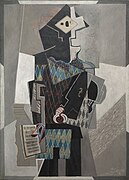
Pablo Picasso, 1918, Arlequin au violon (Harlequin with Violin), oil on canvas, 142 10 100.3 cm, The Cleveland Museum of Art, Ohio
-
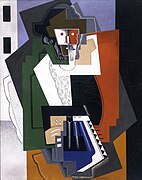
Gino Severini, 1919, Bohémien Jouant de L'Accordéon (The Accordion Player), Museo del Novecento, Milan
-

Press articles and reviews [edit]
-

(centre) Jean Metzinger, c.1913, Le Fumeur (Man with Pipe), Carnegie Museum of Art, Pittsburgh; (left) Alexander Archipenko, 1914, Danseuse du Médrano (Médrano Two), (right) Archipenko, 1913, Pierrot-carrousel, Solomon R. Guggenheim Museum, New York. Published in Le Petit Comtois, thirteen March 1914
-

Paintings by Fernand Léger, 1912, La Femme en Bleu, Woman in Bluish, Kunstmuseum Basel; Jean Metzinger, 1912, Dancer in a café, Albright-Knox Fine art Gallery; and sculpture past Alexander Archipenko, 1912, La Vie Familiale, Family Life (destroyed). Published in Les Annales politiques et littéraires, northward. 1529, 13 Oct 1912
-
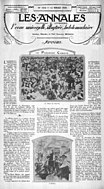
Paintings by Gino Severini, 1911, La Danse du Pan-Pan, and Severini, 1913, 50'jitney. Published in "Les Annales politiques et littéraires", Le Paradoxe Cubiste, 14 March 1920
-

Paintings by Gino Severini, 1911, Souvenirs de Voyage; Albert Gleizes, 1912, Man on a Balcony, 50'Homme au balcon; Severini, 1912–xiii, Portrait de Mlle Jeanne Paul-Fort; Luigi Russolo, 1911–12, La Révolte. Published in "Les Annales politiques et littéraires", Le Paradoxe Cubiste (continued), due north. 1916, 14 March 1920
-
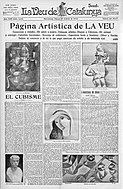
Jean Metzinger, c.1911, Nature morte, Compotier et cruche décorée de cerfs; Juan Gris, 1911, Study for Man in a Café; Marie Laurencin, c.1911, Testa ab plechs; August Agero, sculpture, Bust; Juan Gris, 1912, Guitar and Glasses, or Banjo and Glasses. Published in Veu de Catalunya, 25 Apr 1912
-

Umberto Boccioni, 1911, La rue entre dans la maison; Luigi Russolo, 1911, Souvenir d'une nuit. Published in Les Annales politiques et littéraires, one December 1912
-

Francis Picabia, paintings published in the New York Tribune, 9 March 1913. Picabia held his first 1-human show in New York, Exhibition of New York studies by Francis Picabia, at 291 fine art gallery (formerly Little Galleries of the Photo-Secession), March 17 - Apr 5, 1913
-

See also [edit]
- Quaternary dimension in fine art
- Precisionism
- Proto-Cubism
- Rayonism
- Section d'Or
References [edit]
- ^ Jean Metzinger, Notation sur la peinture, Pan (Paris), October–November 1910
- ^ a b Christopher Dark-green, MoMA collection, Cubism, Introduction, from Grove Fine art Online, Oxford University Press, 2009 Archived 2014-08-13 at the Wayback Machine
- ^ Cubism: The Leonard A. Lauder Drove, The Metropolitan Museum of Art, New York, 2014 Archived 2015-05-17 at the Wayback Machine
- ^ Christopher Green, MoMA collection Cubism, Origins and application of the term, from Grove Art Online, Oxford University Press, 2009 Archived 2014-06-13 at the Wayback Auto
- ^ a b c d due east f g h i j k l m n o p q r Christopher Light-green, 2009, Cubism, MoMA, Grove Fine art Online, Oxford University Press Archived 2014-08-13 at the Wayback Machine
- ^ Joann Moser, Jean Metzinger in Retrospect, Pre-Cubist works, 1904–1909, The University of Iowa Museum of Art, J. Paul Getty Trust, University of Washington Printing 1985, pp. 34–42
- ^ Hajo Düchting, Orphism, MoMA, Grove Art Online, Oxford University Printing, 2009
- ^ Magdalena Dabrowski, Geometric Abstraction, Heilbrunn Timeline of Art History, The Metropolitan Museum of Art, New York, 2000
- ^ a b Christopher Green, 2009, Cubism, Meanings and interpretations, MoMA, Grove Art Online, Oxford University Press, 2009 Archived 2015-07-02 at the Wayback Machine
- ^ Christina Lodder, 2009, Constructivism, Formation, 1914–21, MoMA, Grove Art Online, Oxford Academy Press, 2009 Archived 2008-10-24 at the Wayback Machine
- ^ Honour, H. and J. Fleming, (2009) A World History of Art. seventh edn. London: Laurence Male monarch Publishing, p. 784. ISBN 9781856695848
- ^ a b Douglas Cooper, "The Cubist Epoch", pp. 11–221, 232, Phaidon Press Limited 1970 in association with the Los Angeles Canton Museum of Art and the Metropolitan Museum of Art ISBN 0-87587-041-four
- ^ a b c Cooper, 24
- ^ Louis Vauxcelles, Exposition Braques, Gil Blas, 14 Nov 1908, Gallica (BnF)
- ^ a b Danchev, Alex (March 29, 2007). Georges Braque: A Life. Penguin Books Limited. ISBN9780141905006 – via Google Books.
- ^ Futurism in Paris – The Avant-garde Explosion, Centre Pompidou, Paris 2008
- ^ Louis Vauxcelles, Le Salon des Indépendants, Gil Blas, 25 March 1909, Gallica (BnF)
- ^ D.-H. Kahnweiler. Der Weg zum Kubismus (Munich, 1920; Eng. trans., New York, 1949)
- ^ C. Greenberg. The Pasted-paper Revolution, ARTnews, 57 (1958), pp. 46–9, 60–61; repr. as 'Collage' in Art and Culture (Boston, 1961), pp. 70–83
- ^ Berger, John (1969). The Moment of Cubism . New York, NY: Pantheon. ISBN9780297177098.
- ^ a b "Fondation Gleizes, Chronologie (in French)" (PDF). Archived from the original (PDF) on Nov 12, 2008.
- ^ "Gil Blas / dir. A. Dumont". Gallica. March 18, 1910.
- ^ Daniel Robbins, Jean Metzinger: At the Center of Cubism, 1985, Jean Metzinger in Retrospect, The University of Iowa Museum of Art, J. Paul Getty Trust, University of Washington Press
- ^ a b c Guillaume Apollinaire, Les Peintres cubistes: Méditations esthétiques (Paris, 1913)
- ^ "Eiffel Belfry". The Guggenheim Museums and Foundation. Archived from the original on February 28, 2014.
- ^ "The Wild Men of Paris". www.architecturalrecord.com. Archived from the original on Apr 24, 2016.
- ^ a b "Eccentric Schoolhouse of Painting Increases Its Faddy in the Current Art Exhibition --- What Its Followers Attempt to Do". October 8, 1911. Archived from the original on March five, 2016 – via NYTimes.com.
- ^ a b "The "Cubists" Dominate Paris' Fall Salon, The New York Times, October 8, 1911 (Loftier-resolution PDF)" (PDF).
- ^ Philadelphia Museum of Fine art, Marcel Duchamp, Nude Descending a Staircase, No. 2 Archived 2017-09-eighteen at the Wayback Automobile
- ^ "Statens Museum for Kunst, National Gallery of Kingdom of denmark, Jean Metzinger, 1911–12, Woman with a Horse, oil on canvas, 162 × 130 cm". Archived from the original on January 15, 2012.
- ^ a b Marking Antliff and Patricia Leighten, A Cubism Reader, Documents and Criticism, 1906–1914, University of Chicago Press, 2008, pp. 293–295
- ^ Ballad A. Hess, Manuel de Falla and Modernism in Espana, 1898–1936, University of Chicago Press, 2001, p. 76, ISBN 0226330389
- ^ Commemoració del centenari del cubisme a Barcelona. 1912–2012, Associació Catalana de Crítics d'Art – ACCA
- ^ Mercè Vidal, L'exposició d'Art Cubista de les Galeries Dalmau 1912, Edicions Universitat Barcelona, 1996, ISBN 8447513831
- ^ David Cottington, Cubism in the Shadow of War: The Avant-garde and Politics in Paris 1905–1914, Yale University Press, 1998, ISBN 0300075294
- ^ "Exposició d'Art Cubista". Dalmau Galleries.
- ^ Joaquim Folch i Torres, Els Cubistes a cân Dalmau, Pàgina artística de La Veu de Catalunya Archived 2018-04-22 at the Wayback Machine (Barcelona) 18 April 1912, Any 22, núm. 4637–4652 (sixteen–thirty abr. 1912)
- ^ Joaquim Folch y Torres, "El cubisme", Pàgina Artística de La Veu, La Veu de Catalunya, 25 April 1912 (includes numerous articles on the artists and exhibition)
- ^ a b William H. Robinson, Jordi Falgàs, Carmen Belen Lord, Barcelona and Modernity: Picasso, Gaudí, Miró, Dalí, Cleveland Museum of Fine art, Metropolitan Museum of Art (New York), Yale University Press, 2006, ISBN 0300121067
- ^ Cubist caricature, Esquella de La Torratxa, Núm 1740 (three maig 1912)
- ^ a b "[Exposició d'Art Cubista - Noticiero Universal]". Dalmau Galleries.
- ^ Jaime Brihuega, Las Vanguardias Artísticas en España 1909–1936, Madrid. Istmo.1981
- ^ "Le Journal". Gallica. October five, 1912. Archived from the original on September 4, 2015.
- ^ a b Journal officiel de la République française. Débats parlementaires. Chambre des députés, 3 Décembre 1912, pp. 2924–2929. Bibliothèque et Archives de l'Assemblée nationale, 2012–7516 Archived 2015-09-04 at the Wayback Machine. ISSN 1270-5942
- ^ Patrick F. Barrer: Quand l'art du XXe siècle était conçu par les inconnus, pp. 93–101, gives an business relationship of the contend.
- ^ "biography". www.peterbrooke.org.uk. Archived from the original on May 22, 2013.
- ^ "Albert-Gleizes-œuvre". September 18, 2007. Archived from the original on 2007-09-18.
- ^ a b "The History and Chronology of Cubism, p. v". Archived from the original on March xiv, 2013.
- ^ "La Section d'Or, Numéro spécial, nine Octobre 1912". Archived from the original on April iii, 2017.
- ^ Cooper, 20–27
- ^ a b c d e f g Robbins, Daniel (Apr 19, 1964). "Albert Gleizes, 1881-1953 : a retrospective exhibition". [New York : Solomon R. Guggenheim Foundation] – via Internet Archive.
- ^ Louis Chassevent, Les Artistes Indépendants, 1906, Quelques Petits Salons. Paris, 1908. Chassevent discussed Delaunay and Metzinger in terms of Signac's influence, referring to Metzinger's "precision in the cut of his cubes..."
- ^ a b Robert Herbert, Neo-Impressionism, The Solomon R. Guggenheim Foundation, New York, 1968
- ^ A. Gleizes and J. Metzinger. Du "Cubisme", Edition Figuière, Paris, 1912 (Eng. trans., London, 1913)
- ^ "Mercure de France : série moderne / directeur Alfred Vallette". Gallica. December 1, 1912. Archived from the original on September four, 2015.
- ^ a b Cottington, David (April 19, 2004). Cubism and Its Histories. Manchester Academy Printing. ISBN9780719050046. Archived from the original on January one, 2016 – via Google Books.
- ^ Christopher Light-green, Cubism and Its Enemies: Modern Movements and Reaction in French Art, 1916–1928 Archived 2016-01-01 at the Wayback Machine, Yale University Press, New Haven and London, 1987, ISBN 0300034687
- ^ "The Museum of Modern Art". Moma.org. Retrieved 2011-06-11 .
- ^ Kolokytha, Chara; Hammond, J.G.; Vlčková, Lucie. "Cubism". Routledge Encyclopedia of Modernism.
- ^ Annal, Asia Art. "Cubism in Asia: Unbounded Dialogues – Report". aaa.org.hk . Retrieved 2018-12-22 .
- ^ Gris, Juan. "Portrait of Pablo Picasso". The Fine art Plant of Chicago . Retrieved 2021-06-07 .
- ^ Pablo Picasso, 1909–10, Caput of a Adult female, statuary, published in Umělecký Mĕsíčník, 1913 Archived 2014-03-03 at the Wayback Car, Blue Mount Project, Princeton University
- ^ Robert Rosenblum, "Cubism," Readings in Art History 2 (1976), Seuphor, Sculpture of this Century
- ^ Balas, Edith (Apr 19, 1998). Joseph Csáky: A Pioneer of Modernistic Sculpture. American Philosophical Lodge. ISBN9780871692306. Archived from the original on January 1, 2016 – via Google Books.
- ^ a b Architecture and cubism. Centre canadien d'architecture/Canadian Centre for Architecture : MIT Press. April xix, 2002. OCLC 915987228 – via Open WorldCat.
- ^ a b c "The Collection | MoMA". The Museum of Modern Art. Archived from the original on Apr 5, 2012.
- ^ P. R. Banham. Theory and Design in the First Machine Age (London, 1960), p. 203
- ^ Choay, Françoise, le corbusier (1960), pp. 10–11. George Braziller, Inc. ISBN 0-8076-0104-vii
- ^ "Albert Gleizes and Jean Metzinge, except from Du Cubisme, 1912" (PDF). Archived from the original (PDF) on June 2, 2013.
- ^ La Maison Cubiste, 1912 Archived 2013-03-13 at the Wayback Machine
- ^ Kubistische werken op de Armory Show Archived 2013-03-13 at the Wayback Car
- ^ "Detail of Duchamp-Villon's Façade architecturale, 1913, from the Walt Kuhn Family unit papers and Armory Show records, 1859-1984, bulk 1900-1949". www.aaa.si.edu. Archived from the original on March xiv, 2013.
- ^ "Catalogue of international exhibition of modern art: at the Arsenal of the Threescore-ninth Infantry". Association of American Painters and Sculptors. April nineteen, 1913 – via Cyberspace Annal.
- ^ Green, Christopher (January 1, 2000). Art in France, 1900-1940. Yale Academy Printing. ISBN0300099088. Archived from the original on November 30, 2016 – via Google Books.
- ^ Green, Christopher (2000). Joseph Csaky's staircase in the dwelling of Jacques Doucet. ISBN0300099088. Archived from the original on 30 Apr 2016. Retrieved 18 December 2012.
- ^ Male monarch, Aestheticus (xiv April 2011). "Jacques Doucet's Studio St. James at Neuilly-sur-Seine". Aestheticusrex.blogspot.com.es. Archived from the original on 27 March 2013. Retrieved eighteen December 2012.
- ^ Imbert, Dorothée (1993). The Modernist Garden in France, Dorothée Imbert, 1993, Yale Academy Printing. ISBN0300047169. Archived from the original on xxx April 2016. Retrieved 18 Dec 2012.
- ^ Balas, Edith (1998). Joseph Csáky: A Pioneer of Modern Sculpture, Edith Balas, 1998, p. v. ISBN9780871692306. Archived from the original on 30 April 2016. Retrieved eighteen December 2012.
- ^ a b Boněk, Jan (2014). Cubist Prague. Prague: Eminent. p. 9. ISBN978-80-7281-469-v.
- ^ "Cubism". world wide web.czechtourism.com. CzechTourism. Archived from the original on 16 October 2015. Retrieved 1 September 2015.
- ^ "Cubist architecture". www.radio.cz. Radio Prague. Archived from the original on xi September 2015. Retrieved 1 September 2015.
- ^ a b c "Czech Cubism". world wide web.kubista.cz. Kubista. Archived from the original on viii October 2015. Retrieved ane September 2015.
- ^ Rexroth, Kenneth. "The Cubist Verse of Pierre Reverdy (Rexroth)". Bopsecrets.org. Archived from the original on 2011-05-19. Retrieved 2011-06-eleven .
- ^ Reverdy, Pierre. "Title Page > Pierre Reverdy: Selected Poems". Bloodaxe Books. Archived from the original on 2011-05-27. Retrieved 2011-06-xi .
- ^ "Untitled Document". Archived from the original on 2007-08-13. Retrieved 2008-04-07 .
- ^ Berger, John. (1965). The Success and Failure of Picasso. Penguin Books, Ltd. p. 73. ISBN 978-0-679-73725-4.
Further reading [edit]
- Alfred H. Barr, Jr., Cubism and Abstract Art, New York: Museum of Mod Fine art, 1936.
- Cauman, John (2001). Inheriting Cubism: The Impact of Cubism on American Art, 1909–1936. New York: Hollis Taggart Galleries. ISBN0-9705723-4-iv.
- Cooper, Douglas (1970). The Cubist Epoch. London: Phaidon in association with the Los Angeles County Museum of Art & the Metropolitan Museum of Art. ISBN0-87587-041-4.
- Paolo Vincenzo Genovese, Cubismo in architettura, Mancosu Editore, Roma, 2010. In Italian.
- John Golding, Cubism: A History and an Analysis, 1907-1914, New York: Wittenborn, 1959.
- Richardson, John. A Life Of Picasso, The Cubist Insubordinate 1907–1916. New York: Alfred A. Knopf, 1991. ISBN 978-0-307-26665-1
- Mark Antliff and Patricia Leighten, A Cubism Reader, Documents and Criticism, 1906–1914, The University of Chicago Printing, 2008
- Christopher Green, Cubism and its Enemies, Modern Movements and Reaction in French Art, 1916–28, Yale University Press, New Oasis and London, 1987
- Mikhail Lifshitz, The Crisis of Ugliness: From Cubism to Pop-Art. Translated and with an Introduction past David Riff. Leiden: BRILL, 2018 (originally published in Russian by Iskusstvo, 1968)
- Daniel Robbins, Sources of Cubism and Futurism, Art Journal, Vol. 41, No. 4, (Winter 1981)
- Cécile Debray, Françoise Lucbert, La Section d'or, 1912-1920-1925, Musées de Châteauroux, Musée Fabre, exhibition catalogue, Éditions Cercle d'fine art, Paris, 2000
- Ian Johnston, Preliminary Notes on Cubist Architecture in Prague, 2004
External links [edit]
 | Wikimedia Commons has media related to Cubism. |
 | Wikiquote has quotations related to: Cubism |
 | Wait upward cubism in Wiktionary, the complimentary lexicon. |
- Cubism, Heilbrunn Timeline of Fine art History, Metropolitan Museum of Art
- Cubism, Agence Photographique de la Réunion des musées nationaux et du Grand Palais des Champs-Elysées (RMN)
- Czech Cubist Architecture
- Cubism, Guggenheim Collection Online
- Index of Historic Collectors and Dealers of Cubism, Leonard A. Lauder Research Center for Modern Art, Metropolitan Museum of Art
- Elizabeth Carlson, Cubist Manner: Mainstreaming Modernism after the Armory, Winterthur Portfolio, Vol. 48, No. 1 (Jump 2014), pp. 1–28. doi:x.1086/675687
Source: https://en.wikipedia.org/wiki/Cubism
0 Response to "Breaking Apart an Object and Then Recomposing the Fragmented Pieces Art Defintion"
Post a Comment